
Australian Vintage Limited – Step #3

To be honest I was a little reluctant to open up the ‘My Company’ tab last Friday afternoon, considering most of the blogs I had read had stated how disappointed they were to get a company from overseas. So, when I finally clicked the link and scrolled down the page to find my name, I was relieved to know that I had an Australian company! (Not that it really matters as the more I looked around I realised the only difference is really just the currency.) I was even more excited to see that my company was ‘Australian Vintage Limited’. (AVL)
Now, I’m not a big wine drinker, (a $5.00 bottle of ‘Gossips, Moscato’ and I’m happy), but most of my friends are, so I do know a little bit about nice wine. I started to flick through the AVL website and was quite impressed. So here is a little bit of background.
In 1992, the company’s name was originally ‘McGuigan Wines’ and was established by Brian McGuigan and his family. Between 1994 and 1999, Simeons Wine Limited was founded, ‘Tempus Two’ brand was launched and ‘Yaldara Barossa Valley’ was acquired. (I actually recognised this brand! McGuigan Wines then went on to merge with Simeons Wine in 2002, making them the 4th largest wine group in Australia.
Between 2003 and 2007, ‘Miranda Wines’ and ‘Nepenthe Wines’ were acquired, (Miranda Wines also created ‘Passion Pop’ in 1977-1978 and sold its rights to AVL when they were acquired), and shareholders voted to change the name to Australian Vintage Limited in 2008. Below are some impressive awards they have won.

I did the good old fashioned “google search’ and found a really interesting video called “Vine to glass” and surprisingly realised I knew very little about the production of wine.
I had been going through the Annual Reports for the business and successfully found the financials that I needed to start my spreadsheet. I was feeling quietly confident about this task as I have been working with spreadsheets at work a little, but I never really knew or understood what I was actually doing so this part was exciting! And then I started! Holy Moly! How wrong was I to think i had this part in the bag! Basically, everything i thought i knew was wrong, all of the different names for the financial statements threw me off, and then i had to just knuckle down and get back to basics. I had to start from scratch. I surprised myself as to how little i knew about how businesses worked in general and it worried me that there wasn’t a lot that i did understand.
I really don’t know why things have been made to be so difficult. Why do we have so many different names for balance sheets/income statements and changes in equity? Wouldn’t it just be easier to all just be the same? I’m sure I will understand the different terms as I continue on. Slowly, as I was putting in the numbers and adding things up, I started to notice things piece together. I noticed I was using the accounting equations that I had just learnt about! I had actually learnt something the right way!

I felt then I was back on track. I agree with Maria Tyler from her video, that inputting every line individually helped me understand more about what I was entering. Just by having to double check spelling and the equations, I was picking up on what things were, easier. I am so used to just copying and pasting in my job it has made me lazy. I think this has a lot to do with why I don’t understand what I am doing a lot of the time. I have noticed I have been asking a lot more questions now at work and wanting to know more about what I am entering.
I was a lucky one that had between 88 – 92 pages of financial Statements to go through. As I have been reading through other students’ financials, I noticed some of theirs were 200 pages plus! I still had difficulty finding the information I needed, until I found a handy little line at the bottom of the pages that referred me to notes! This made things a little easier, especially when I got stuck doing my 2016-2017 financials entering. I noticed things weren’t adding up and thought I was going a little crazy from my hectic week! (I had 2 sick kids for a week plus work, so not much sleep happening, then I ended up in hospital with a gall bladder attack.) So, after I watched Maria’s Company Statement video, (again), I realised I had missed the part where she said some companies have “adjustments for restated financials”.
What is a restated financial?!!!

My understanding is that a restated financial is when something has had to be changed and documented. From what I can see, it is documented in the next financial year, which could cause impact on the next year’s profits and losses. This could be due to an accounting error, a misinterpretation or even a policy change. I do believe we will be working on this more in our next assignment, but I thought I would have a look and see if I could figure this one out on my own.
I eventually found the adjustments in a note. (shown below).
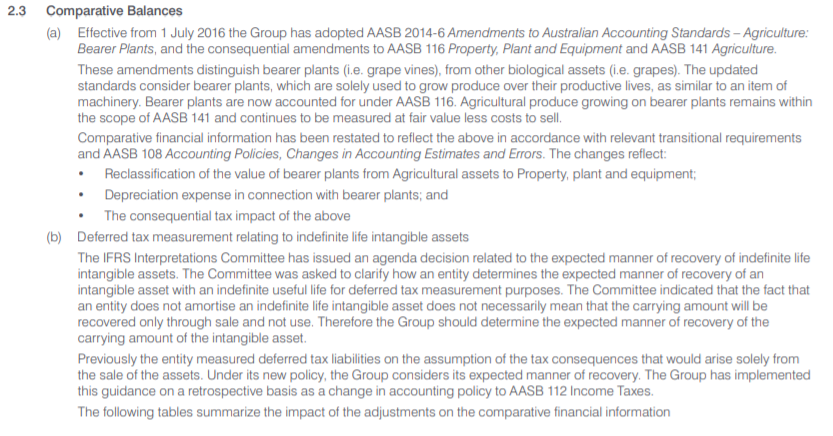
I still don’t comprehend it completely, but my understanding is that there was a change in accounting policies where the grape vines, (bearer plants), have been reclassified from ‘agricultural assets’ to ‘property, plant and equipment’. So, they are simply treated as a similar item to machinery and these were accounted for under the AASB as they are solely used to grow the produce. This means they are measured at fair value less costs to sell. This led me to understand that if it is classed as machinery, it then would have a depreciation, (a reduction in the value of an asset over time, due in particular to wear and tear), thus having an impact on its tax. Please correct me if I am wrong or if I am way off track!
I noticed that AVL had a massive loss in 2016 due to the ‘Brexit Impact’. (British Exit Impact). Bulk wine sales were down 77% ($6.8 million) due to the UK’s decision to leave the European Union, resulting in the British Pound to fall to its lowest dollar value in 30 years. On the other hand, cash flow from operating activities improved by $4.4 million. By 2017, cash flow improved by $7.5 million to $14.0 million, so AVL is definitely on the climb in its success. One thing I really like about my company is that it is energy efficient. It plans to install 1,640Kw solar panels at its Buronga Hill Winery, a 300Kw solar panel system at its Merbein packing facility and it is planning to develop a new vineyard across from the Buronga Hill Winery that will use all of the waste water from the winery.
It is great to see that non-alcohol and reduced alcoholic wine is becoming a trend. Australian Vintage Limited has taken this concept on board and is proving it to be quite popular. In 2013 it installed a ‘spinning cone column’, which gives them an advantage over other wine producers as they have the only one in Australia that produces low alcoholic wine. The column allows the alcohol to be reduced at 42 degrees, rather than the standard 60 degrees, allowing the alcohol to be reduced ‘slower’ and ‘gentler’ allowing it to retain its flavour. I thought this was pretty cool.
I have found doing this part of the assessment a bit difficult. I am still trying to understand all the numbers, but as I read other people’s drafts and interpretations, I get a better understanding every day. My next goal is to ask for more help. I am finding it easy to write down my thoughts but stepping out of my comfort zone and asking those ‘silly’ questions is proving to be more difficult than I thought.
Please feel free to leave me some feedback, as this is also the first time I have linked pages and referenced websites, so I am still not feeling that confident in this area.
References
https://www.mcguiganwines.com.au/
https://en.wikipedia.org/wiki/Australian_Vintage
https://www.australianvintage.com.au/our-company/history/
https://www.conetech.com/pages/process_SCCprocess.html
Financial Statements – Step #4

 Bec's Blog :)